This project was a competition entry with the design team consisting of two members, Ruslan Antonenko and Justin Vermeulen. The Jury Panel: Kazuyo Seijima, Winy Maas (MVRDV), Ben van Berkel (UNStudio), Nicola Scaranaro (Foster+Partners), Carlo Ratti. This competition entry was published and rewarded by being selected as one of the finalists by the jury panel, September 2020.
EMBRACING THE DESERT
In the driest state of the United States, one can find the Las Vegas Valley, situated in a relatively high-altitude portion of the Mojave Desert, with a subtropical hot-desert climate. An area that has evolved and developed over thousands of years, aging and being shaped by the elements resulting in a unique characteristic landscape. The valley where the site is located is a fault-bounded structural and hydrologic basin made of alluvial-fan deposits functioning as an attached feeder valley for the context. Intervening with such a majestic scenery and aged landscape requires a considerate approach. In this respect, we believe that an architectural intervention shouldn’t ignore or challenge the surroundings, but rather embrace it. Besides the areas marvelous characteristics, the extreme climatologic factors play a big role in defining a suitable proposal. Our aim is to join forces with- and embrace the desert. We want to offer shelter from the extremities while at the same time glorifying the desert.
That is why the positioning of the building, the morphology and the facade will be optimized to provide protection, while offering the best possible panoramic views of the desert. The basic shape should be a respectful gesture towards the desert; embracing the existing vegetation and site, possibly offering a more sheltered desert environment within- which could in return become a local ‘‘island’’ for species to flourish- and on the other side facing outwards; overlooking the desert and revealing the magnitude and grandness of it all. By joining forces with the desert a lot of energy and insulation challenges can be resolved. Besides restoring and preserving the natural habitat- by utilizing the available ground deep underneath the desert surface- the extreme environmental conditions can be overcome. While some amenities can benefit from this approach, others may not. That’s why the program should be composited carefully and correctly, corresponding to the users needs- & becoming a sanctum for science and serenity.
THE SITE AND ACCESSIBILITY
Situated in the Nevada desert, among beautiful mountain ranges and close to Vegas, a big initial intervention area was introduced.
We believe in retaining and reverencing the desert, thus we propose an alternative-but logical means of transport; The hyperloop. The only way to reach the research center will be by the hyperloop-from any big city.
Not only people, but also supplies will be transported by this innovative and efficient means of transport, enhancing the full experience for all visitors and staff.
We propose to divide the site into four areas and a quarter of which which will be designated for the research center. Hence leaving nature temporarily untouched in the remaining areas until future expansion. In the future there might be a need for a production and assembly factory. This type of development could potentially benefit from the vast amount of reserved land.
Since the site is surrounded by an intriguing context we carefully position the research center so it can access the main four different views. South-west and North-east look out over grand mountain ranges. While North-west overlooks the wonders of the desert, South-east faces the skyline of Las Vegas.
Environmental analysis
SUN
The annual solar analysis illustrates the extreme dry bulb temperatures on the site. During summer it will be >30 degrees. During autumn and spring temperatures will be more moderate. In the winter temperatures drop below 10 degrees. Because of the steep angle of the sun any kind of rooftop could be easily overheated. The radiance map shows the amount of raw solar energy (kWh/m2) that could potentially be generated on site with solar panels.
WIND
The annual wind analysis portrays an interesting pattern in wind directions and intensity. The first figure shows heavy wind, particularly during the months February-June. The first wind rose displays the occurrence of wind- mapped to direction and speed. The second wind rose combines dry-and wet bulb temperatures with the windspeed. The extreme south-western wind is hot and dry. Creating shelter from and harnessing the (wind) conditions would be favourable.
HUMIDITY
The annual humidity analysis displays a clear pattern. During summer it’s very dry, barely any condensation or rainfall. In November there is a short, intense period of rainfall. During winter a pattern of condensation with nightly rainfall. The psychrometric chart tells us that the area of thermal comfort on an annual scale is approximately 19% of the time, clothing levels taken into consideration. This environment demands mainly indoor activity.
GROUND TEMP
The ground temperature analysis shows the ground level temperatures throughout the year. The graph reveals something interesting. First of all, we see a linear decline in temperature during both summer and winter when the depth increases. In autumn and spring there is a more gradual decline in temperature. Most prominently visible is that below 9 meters the ground temperature reaches an average temperature of 19.8 degrees centigrade.
CONCLUSION
The extreme and harsh weather conditions require a strategic design approach. Overheating can be reduced by minimizing roof area and building deep underneath the desert ground. While offering protection against the wind, a mechanical facade installation could harness the hot wind by extracting water particles to create indoor cooling and humidity.
Concept development
GLORIFY THE DESERT INSIDE
A gesture to accentuate the beauty of the desert and a chance to admire it up close
VIEWS TOWARDS OUTSIDE
Providing panoramic views to portray and overlook the ever evolving desert landscape
SMOOTH SUNLIGHT DISTRIBUTION
A smooth surface improves sunlight distribution on the facade and improves wind dispersion
CAPTURE AND CONVERT HOT WIND
The main face of the building captures the hot desert wind to distill water vapor from the air
VOLUME UNDERNEATH THE SURFACE
Preserving the unique desert landscape by placing > 50% of the building underneath the desert ground
PASSIVE ENERGY UTILIZATION
Utilizing passive insulation properties: the ground temperature below 9m is stable during all seasons
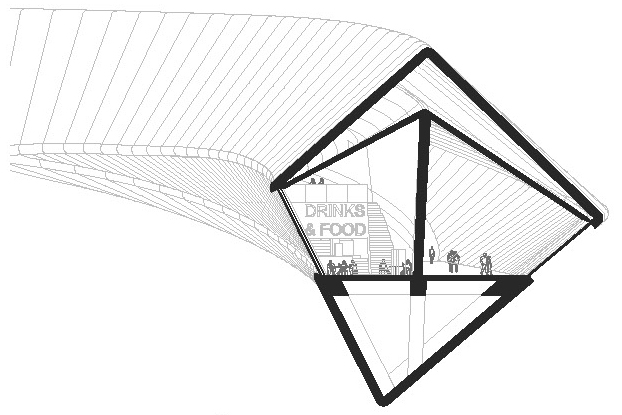
The bridge – the segment of the building that cantilevers – rises up from the desert. While retaining the desert ground underneath, it enables the visitor to experience the grandness of the desert from above.
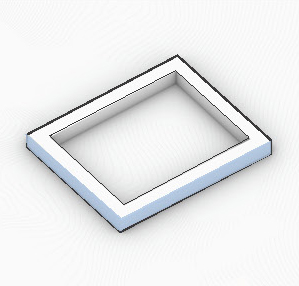
Two interlocking shapes – one above and the other underneath the surface – embody a highly optimized arrangement of program and form. Utilities that require the light of day are positioned above the ground.
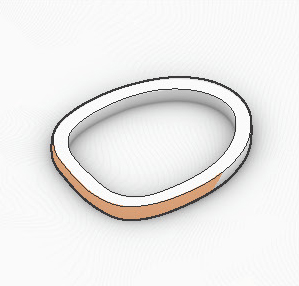
Simple edges and surfaces – gradually shifting shape – form a natural flow and constant transition. Inner and outer structures alternate and transcend, while keeping each other in balance to preserve harmony.
The twisting shape translates into a simple, but complex form. A complimenting gesture towards an ever evolving facade. The conjunction, where the shapes interlock, portrays a rare complexity of spatial quality
THE PROGRAM
An important and unique feature of the proposal is the introduction of an interlaced program.
The different amenities are arranged along the tour, which serves as the main public circulation system for visitors and staff.
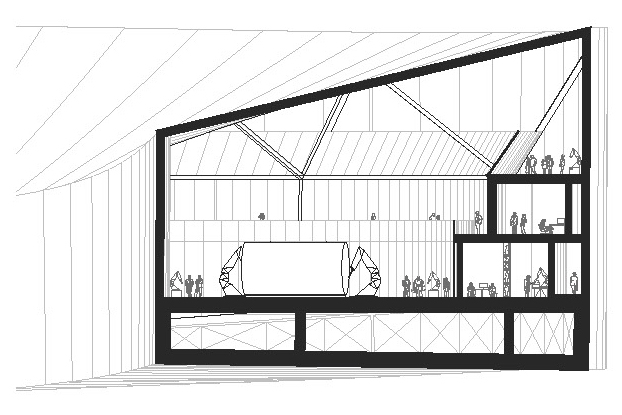
The program gradually bends and morphs along with the main shape of the building. The embodiment of – and constant tension and interaction between – various volumes, enriches the interior spatial quality.
Resulting in various programmatic functions that co-exist and compliment each other.
THE CENTRAL HUB AND VISITOR TOURS
THE RESTAURANT WITH VIEWS
LIVING AND LEISURE AREA
LABS AND OFFICES
TRAINING CENTER
THE CENTRAL HUB
INTERLACED PROGRAM
Plans, sections and visuals
DWELLINGS AND CENTRAL HALL 1:500
POOL, SPA AND FITNESS CENTER 1:50
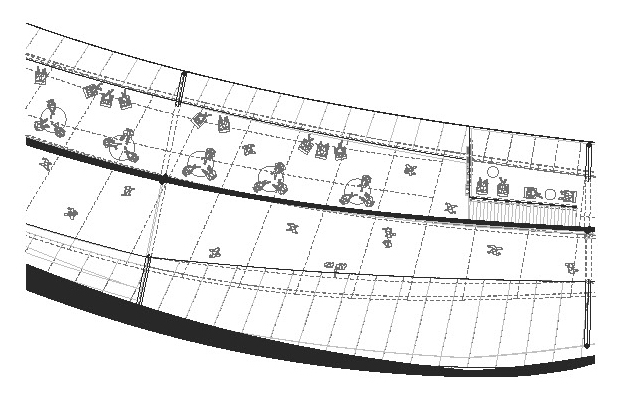
PLAN LAYOUT RESTAURANT 1:500
RESTAURAN, BAR AND VISITOR TOUR 1:500
PLAN LAYOUT HYPERLOOP PRODUCTION HALL 1:500
HYPERLOOP PRODUCTION HALL, LABS AND OFFICES 1:500
The Central Hub
THE HUB
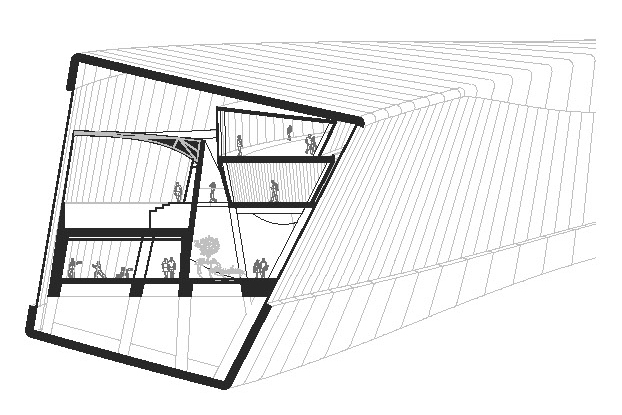
The conjunction of shapes translates into the central hub, which is the heart of the research center. The central hub welcomes visitors, arriving by hyperloop. The hub is designed as a sunken pit, where the temperature is controlled by the width and depth of the space, creating a comfort temperature for the visitors.
CROSS SECTION OF THE CENTRAL HUB 1:200
FACADE CONVERSION SYSTEM
The facade has a wind conversion and water condensation system covering the east facace. This conversion system helps improving the indoor climate. The system converts the hot desert wind into a chill breeze that cascades down through the space.